1. Introduction: Innovations in Automotive Interiors and Solvent-Free Fabrics for a Carbon-Neutral Future
In this era of rapid transformation within the global automotive industry and high-end manufacturing—particularly driven by the explosive growth of electric vehicles (EVs)—the physical spaces we inhabit—whether automotive cabins, recreational vehicles, or high-end commercial spaces—are being redefined. The quality of interior upholstery not only determines the consumer’s sensory experience but also serves as the core vehicle through which brands convey values of environmental protection, health, and sustainability. It is against this industry backdrop that Solvent-free car interior fabric has emerged as a disruptive OEM auto upholstery fabric.
Not only does it completely eliminate the toxic and harmful chemical solvents used in traditional synthetic leather production, but it also achieves unprecedented levels of physical performance, tactile feel, and durability. Thanks to its ability to exceed extremely stringent automotive-grade testing standards, this innovative material is crossing industry boundaries and rapidly penetrating multiple high-demand sectors, including RV interiors, healthcare, commercial furniture, and maternal and infant products. This article will provide an in-depth analysis of international standards for OEM automotive interior fabrics and comprehensively reveal how cutting-edge solvent-free PC-PU leather technology offers global buyers the ultimate solution that combines luxury with sustainability.

2. In-Depth Analysis: What Exactly Are OEM Automotive Interior Fabrics?
2.1 Accurately Understanding the Stringent Definitions and Certifications of OEM (Original Equipment Manufacturer)
In the professional context of the supply chain, OEM refers to “original equipment manufacturers.” Therefore, “OEM automotive interior fabrics” and OEM automotive leather specifically refer to those original materials supplied directly to automotive brands (such as Volkswagen, Toyota, Tesla, etc.) or their Tier 1 suppliers, and used in assembly line production before new vehicles leave the factory.
This is by no means a mere commercial label, but rather a system of extremely rigorous engineering standards. To qualify as an OEM fabric, the material must pass a complex Production Part Approval Process (PPAP) and fully comply with the brand’s officially published Engineering Specifications regarding tensile strength, color consistency, weather resistance, and odor control. Even the slightest quality fluctuation is unacceptable within the OEM system, establishing the highest industry standards for durability and safety.
2.2 The Spillover Effect of OEM Processes: Reshaping Aftermarket Fabric Standards
Traditionally, aftermarket leather upholstery prioritized design diversity and installation flexibility, often compromising on long-term durability testing under extreme conditions. However, as consumer quality expectations rise, this status quo is being disrupted.
As a professional fabric supplier, Caiwing not only excels in the OEM market but has also successfully adapted this original-equipment-level solvent-free production process to the aftermarket—effectively delivering a "game-changing" solution. This means our Solvent-Free PC-PU Leather provides the high-end aftermarket with top-tier fabrics that match or even surpass the safety and durability of Factory match automotive synthetic leather, completely eliminating the common pain points in the traditional modification market, such as unpleasant odors, rapid aging, and peeling.
3. Key International Standards for Materials: Why Is “Solvent-Free” the Inevitable Path?
3.1 Ultimate Durability: Abrasion and Scratch Resistance Tested to 500,000 Cycles
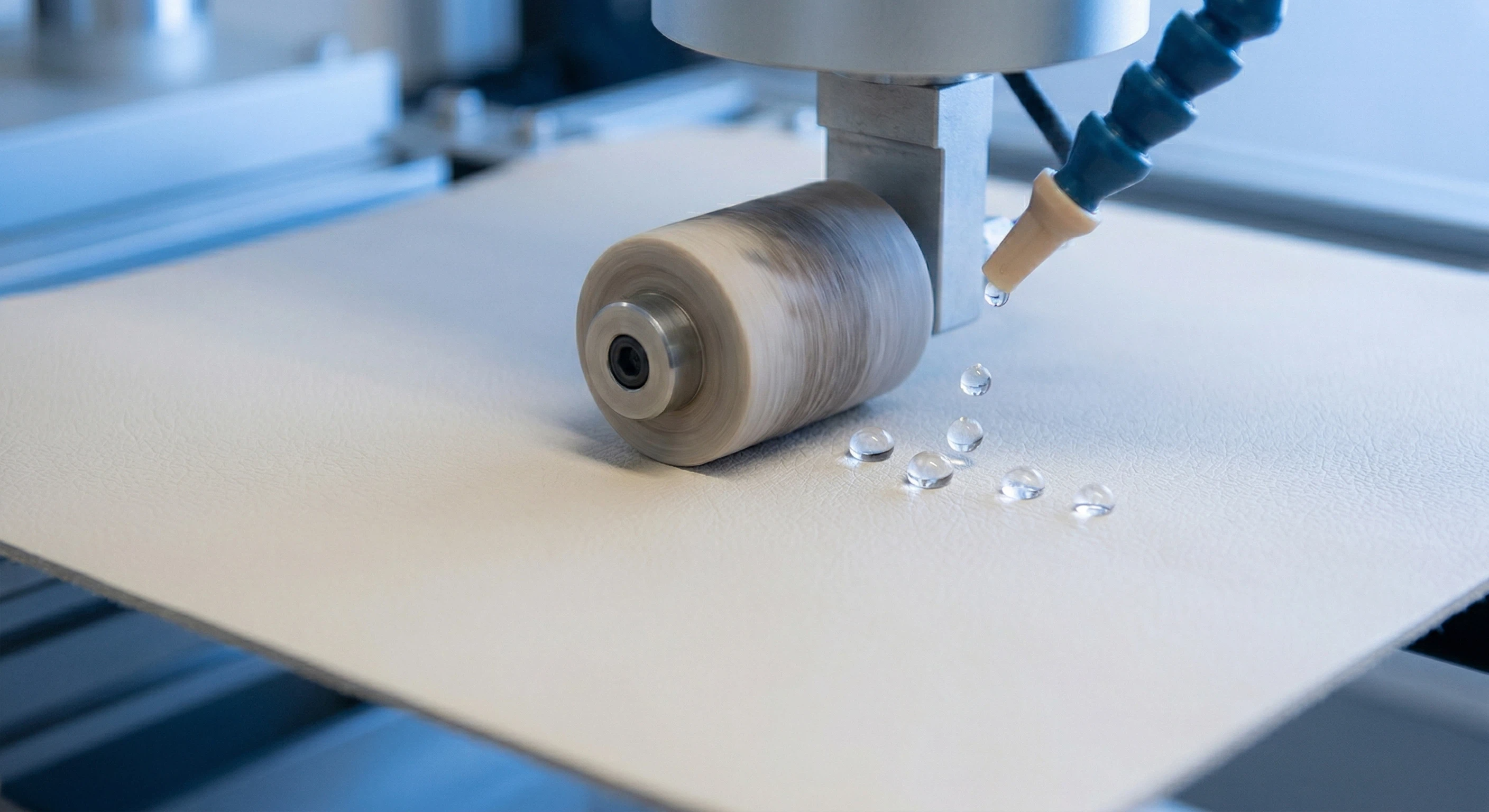
Whether for automotive seats, steering wheels, or high-traffic Contract grade faux leather applications, fabrics must withstand rigorous physical testing. International standard Martindale or Wyzenbeek abrasion tests are key indicators for evaluating this performance. High-quality OEM leather must withstand over 500,000 cycles of Martindale abrasion testing and over 300,000 cycles of Wyzenbeek testing without showing significant surface wear, peeling, or exposure of the backing fabric. Additionally, scratch resistance testing is crucial. Solvent-free PC-PU leather, with its extremely robust polymer cross-linked structure, demonstrates superior durability in such high-intensity usage scenarios.
3.2 The Ultimate Solution for Environmental Compliance: Strict Control of VOC Emissions and Air Quality
As consumer health awareness grows, “Indoor/In-Vehicle Air Quality (VIAQ)” has become a core metric for evaluating the quality of spaces. The pungent odors emitted by traditional interiors primarily stem from volatile organic compounds (VOCs) remaining in the materials. International standards impose strict limits on the emissions of these substances.
The Solvent-Free Process is the ultimate solution to this challenge. By completely eliminating the use of organic solvents during production, this Low VOC automotive leather cuts off the source of emissions at the root, achieving true non-toxicity and odorlessness, and readily qualifying as VDA 278 compliant PU leather.
3.3 All-Weather Adaptability: Withstanding Extreme Temperature Fluctuations and Harsh UV Exposure
Application environments are extremely complex and variable, ranging from the freezing snow and ice of Northern Europe to the scorching desert heat of the Middle East. Drastic fluctuations in temperature and humidity pose significant challenges to fabric stability. Materials meeting OEM standards must pass high-low temperature cycling tests to ensure they do not become hard, brittle, or crack at -40°C, nor become sticky when exposed to intense sunlight at temperatures as high as 85°C.
3.4 Flame Retardancy and Global Top-Tier Passive Safety Certifications
Safety is always the top priority. In accordance with FMVSS 302 or global flammability standards, premium interior materials must possess outstanding flame-retardant properties.Caiwing’s solvent-free PC-PU leather incorporates an eco-friendly flame-retardant mechanism at the molecular synthesis stage, establishing a robust safety barrier without compromising tactile comfort.

4. Key Breakthrough: What Is Solvent-Free PC-PU Leather?
4.1 Pain Points of Traditional Solvent-Based PU Leather and Industry Hazards Posed by DMF Residues
Traditional PU leather relies heavily on organic solvents such as dimethylformamide (DMF) to dissolve resins during production. Despite washing and drying, trace amounts of solvents inevitably remain, leading to unpleasant odors, potential health risks, and accelerated material aging.
4.2 Decoding the Innovative Chemical Structure and Physical Advantages
Polyether-Polycarbonate Hybrid leather represents the pinnacle of current synthetic leather materials science. It completely eliminates solvents, utilizing a 100% solids-content polyurethane prepolymer to form a film directly on the base fabric through precise mechanical mixing and chemical cross-linking reactions.
4.3 Overcoming the Industry’s Hydrolysis Challenge: An Exceptional Lifespan of Over Ten Years
“Hydrolysis” is the number one enemy of synthetic leather. The polycarbonate structure in our solvent-free material endows it with unparalleled hydrolysis resistance. According to the extremely rigorous Jungle Test, its service life in actual high-frequency use environments can reach 7 to 10 years or more.
4.4 A Luxurious Feel Rivaling Top-Grade Genuine Leather
Since there are no microscopic voids left behind by solvent evaporation, the structure is extremely dense and uniform. This 100% solid content endows the material with a rich, substantial feel fully comparable to top-tier Nappa leather.
5. Cross-Industry Empowerment: Diverse High-End Applications

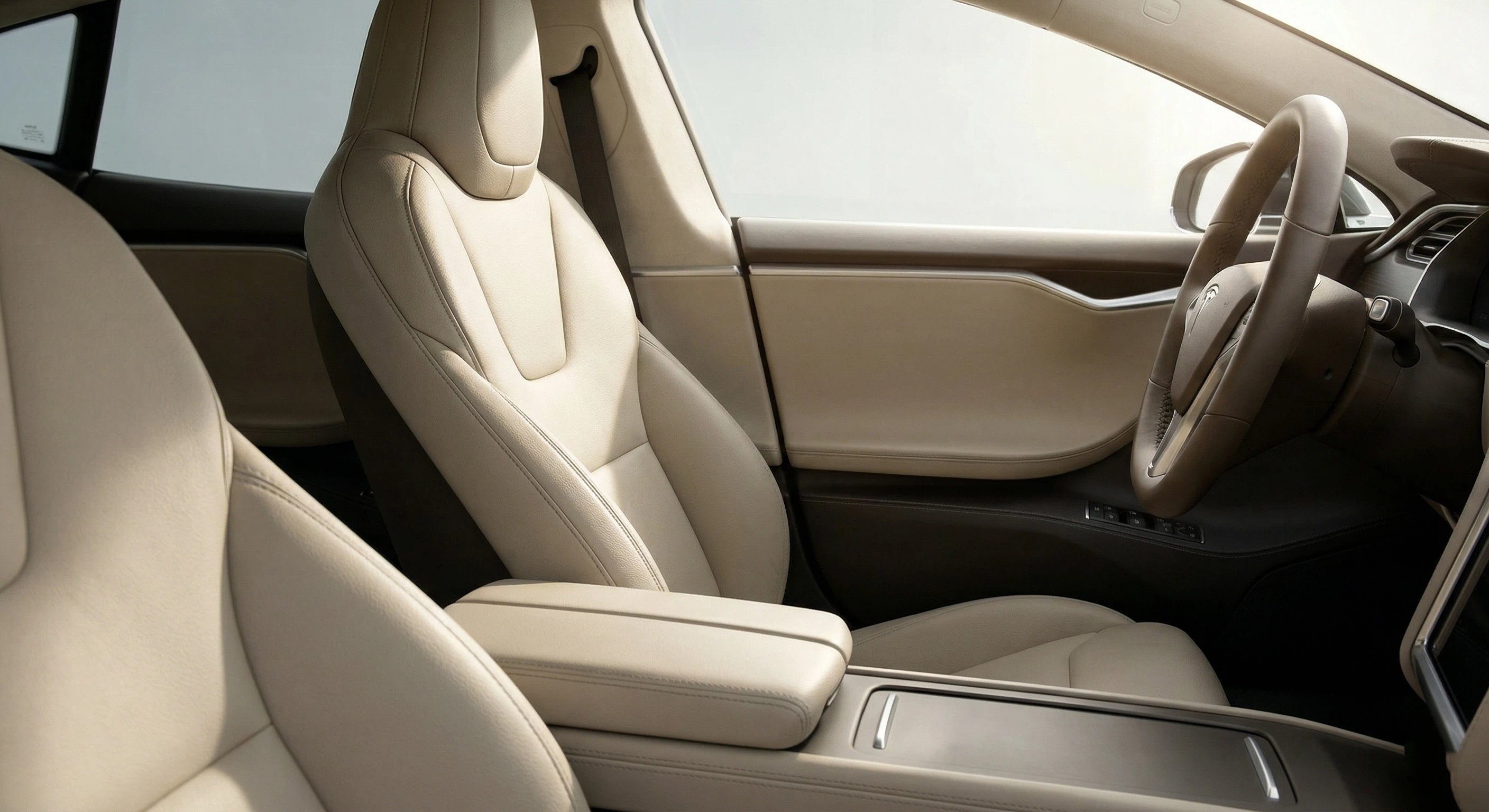
5.1 Green, Low-Carbon Cabins for Premium Passenger Vehicles and EVs
For new energy brands, creating “eco-friendly, vegan, and carbon-neutral” cabins is a core brand priority. As a High-performance PU fabric (HPPU), our solvent-free material is produced with extremely low energy consumption and perfectly aligns with EV owners’ pursuit of a healthy interior environment.
5.2 Automotive Aftermarket & RV Interiors
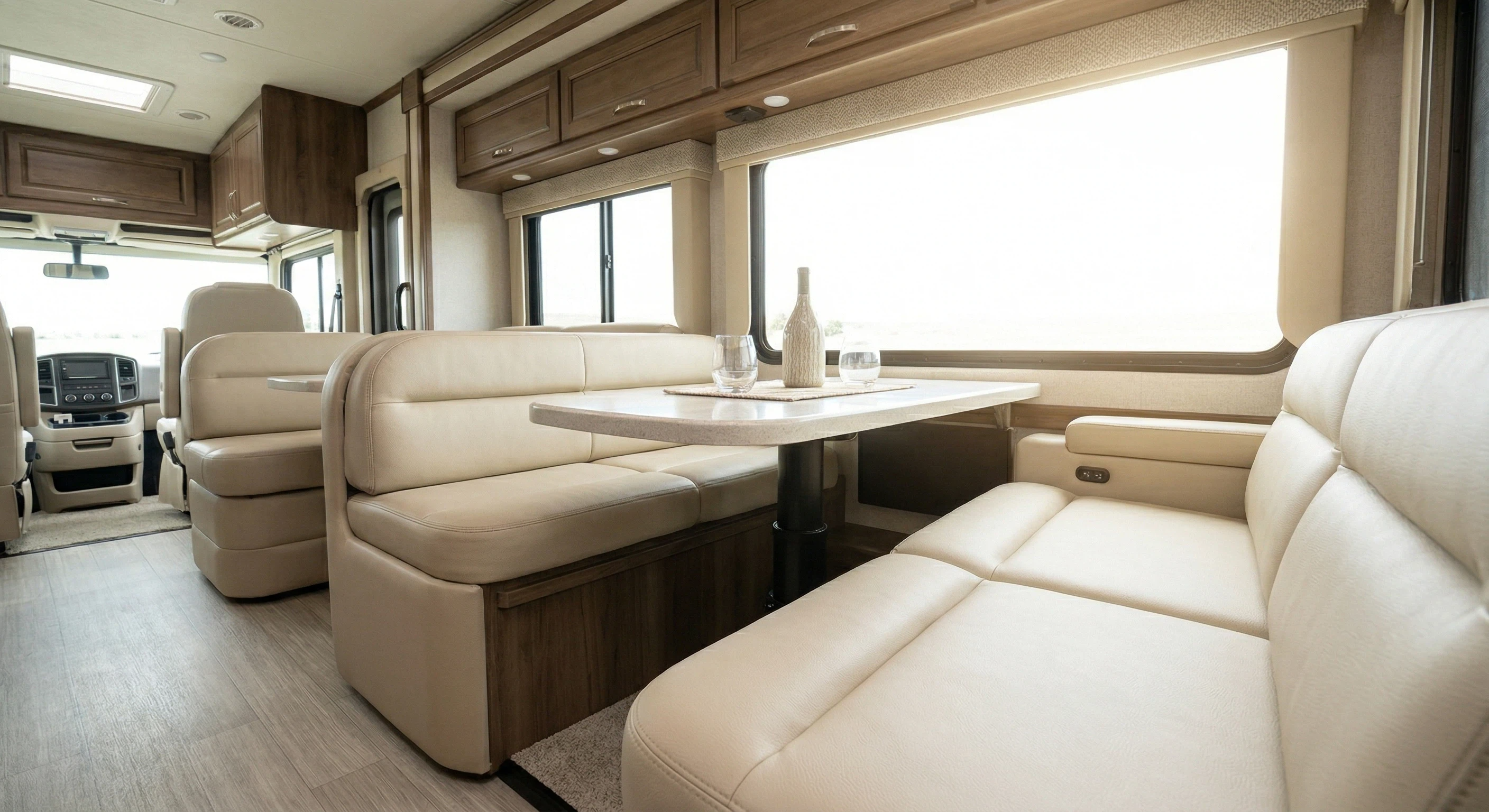
RV interior upholstery fabric is often exposed to extreme outdoor conditions (high UV radiation, high humidity). The high weather resistance of our material makes it the perfect choice for covering wall panels or serving as Camper van cushion synthetic leather. In the aftermarket, it offers OEM-level texture, giving older vehicles a fresh new look.
5.3 Commercial & Industrial Furniture
Commercial task seating fabric in airport terminals, luxury hotel lobbies, and high-end office spaces faces the challenges of extremely high foot traffic. Caiwing fabrics feature exceptional stain resistance and flame retardancy, representing the ultimate solution as Institutional grade faux leather.
5.4 Medical & Healthcare
In medical settings, Healthcare grade polyurethane upholstery must withstand frequent wiping with strong disinfectants without fading or hardening. Our material’s exceptional chemical stability makes it highly resistant to corrosion, proving itself as a reliable Bleach-cleanable PU leather that effectively inhibits bacterial growth.
5.5 Ultimate Safety for Baby and Children’s Products
Caiwing’s fabrics demonstrate exceptional value for applications ranging from strollers to high-end play mats, easily repelling spills and maintaining a hygienic surface.
6. Sourcing and Supply Chain Guide
6.1 A Comprehensive Quality Control and Testing System Grounded in Internationally Recognized Certifications
Quality is the lifeline of high-end manufacturing. Introducing new solvent-free PC-PU leather into your supply chain requires suppliers to provide absolutely reliable quality assurance to mitigate procurement risks.Caiwing has established an extremely rigorous Quality Control & Testing System and holds a full suite of internationally recognized certifications. Our production and quality control processes strictly adhere to the ISO 9001 Quality Management System; simultaneously, to meet the exceptionally stringent standards of the automotive industry, we fully implement and have obtained IATF 16949 (upgraded from the original ISO 16949) certification, the globally unified quality management system for the automotive sector.
Furthermore, to uphold our commitment to truly green manufacturing, our solvent-free production lines have successfully obtained ISO 14001 Environmental Management System certification. These authoritative certifications serve not only as a “passport” for cross-border trade but also as a solid guarantee that every roll of leather delivered to you meets the world’s highest standards in physical performance, environmental metrics, and batch consistency.

6.2 Precise Evaluation of Functional Performance Parameters and Customized Material Specifications
For R&D engineers and global procurement managers, the material selection process must be rigorous and meticulous. We recommend that you thoroughly review the Functional Performance Specifications provided by Caiwing during your initial screening. Please focus on comparing the core data of our Solvent-Free PC-PU Leather against your specific application scenarios, such as tensile strength, chemical resistance metrics (e.g., solvent resistance testing for medical or RV applications), and extremely stringent in-car odor rating requirements.Our highly transparent data presentation, combined with highly customized color matching and embossing services, will effectively assist your team in quickly overcoming technical barriers and successfully implementing your R&D projects.
6.3 From Requesting a New Sample Book to In-Depth Technical Discussions
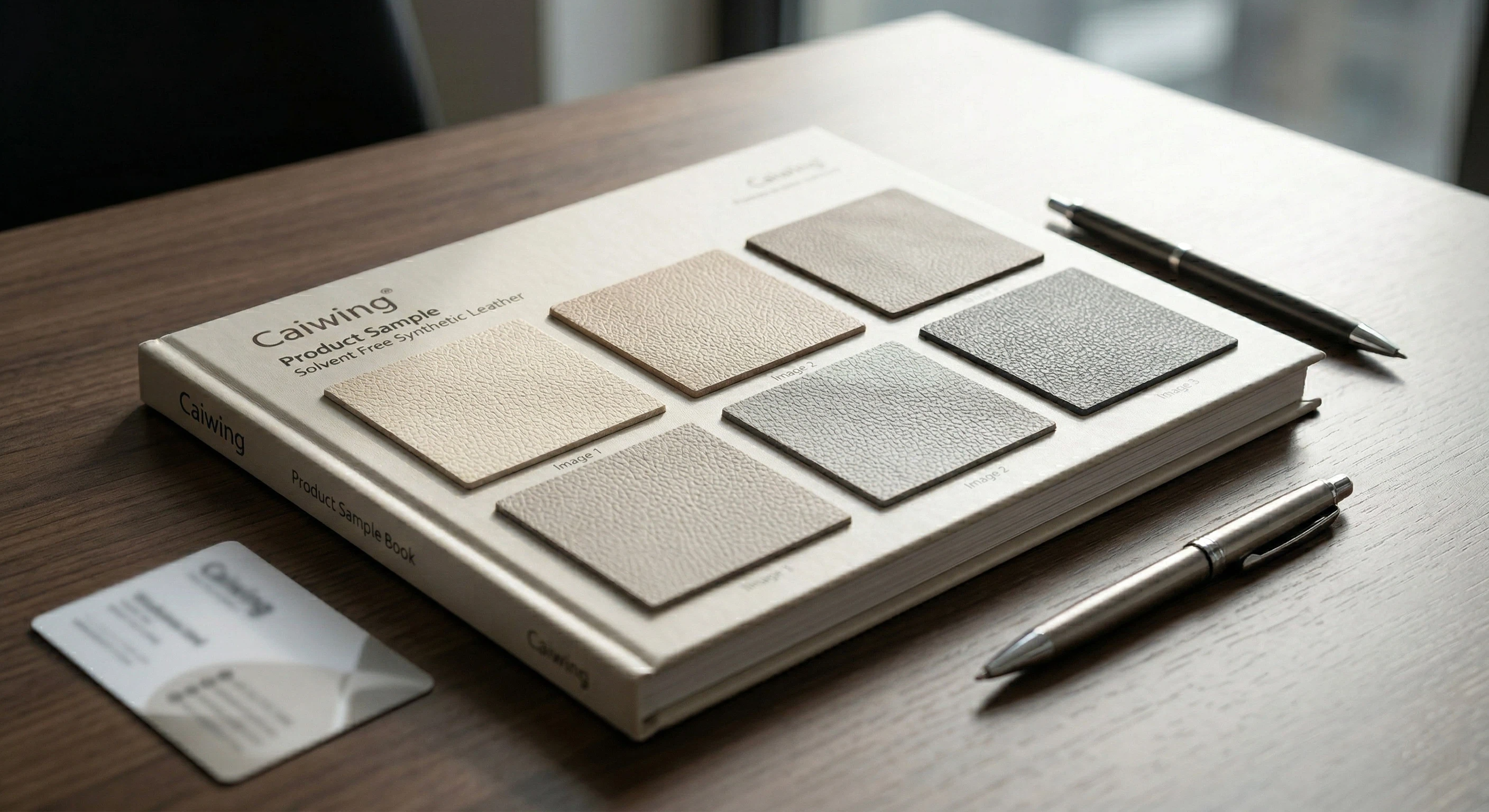
No matter how detailed the data, it cannot replace the real tactile experience. To allow you to experience firsthand the exceptional quality of solvent-free PC-PU leather, which rivals that of genuine leather, Caiwing has recently crafted a brand-new physical sample book featuring the latest popular textures and color palettes.You can request a free copy directly via the form on our website (Request a Custom PC-PU Leather Solution). Additionally, our professional technical team, with extensive experience in international trade and cross-industry services, stands ready to engage in in-depth technical discussions with you to jointly explore and tailor material application solutions that best suit your project.

7. Conclusion
Whether in automotive interiors, medical spaces, or commercial furniture, the criteria for evaluating fabrics are undergoing a paradigm shift. Traditional solvent-based leather can no longer meet the high-end demands of future multi-scenario applications. Solvent-Free PC-PU Leather is redefining the upper limits of OEM grade car interior leather. By choosing Caiwing as your strategic partner, you infuse your brand with a powerful momentum of green sustainability.
8. Frequently Asked Questions (FAQ)
8.1. What is the best automotive leather?
Currently, Solvent-Free PC-PU Leather is widely recognized by the industry as the optimal comprehensive solution. It comprehensively outperforms traditional genuine leather and standard solvent-based synthetic leather in terms of extreme durability, zero VOC emissions, and environmental compliance, making it the ideal Automotive seating polyurethane leather for high-end EVs.
8.2. Is automotive leather real leather?
Not necessarily. The vast majority of mid-to-high-end models today tend to use high-tech synthetic leather, providing more stable physical properties and batches with zero color variation.
8.3. Is solvent-free PC-PU leather significantly more expensive?
Although the initial unit price is slightly higher, it offers exceptional cost-effectiveness over the product’s lifecycle. Take commercial furniture or high-traffic RV interiors as examples: due to their excellent hydrolysis resistance, their actual service life can reach 7–10 years.
8.4. Does this fabric offer advantages for EV lightweighting?
Yes. It offers a significant weight-reduction advantage over traditional genuine leather (typically over 30%) while ensuring extremely high physical strength.
8.5. Is there any synthetic leather with properties similar to OEM automotive leather?
Absolutely. Caiwing’s 100% Polycarbonate PU Leather perfectly matches—and even surpasses—certain OEM standards, delivering world-class performance.