1. Balancing Driving Experience and Cost Efficiency: A Deep Dive into Seat Leather Selection
As the core of a vehicle's interior, seat cover materials not only define the cabin's luxury aesthetics and ergonomic comfort, but also directly dictate long-term durability, eco-friendliness, and manufacturing and maintenance overhead. In today's rapidly evolving automotive landscape, owners and original equipment manufacturers (OEMs) face a technical dynamic between natural leather and synthetic alternatives.
Traditional natural leather for seats maintains its stronghold in the high-end market due to its premium tactile feel. Meanwhile, advanced automotive synthetic leather and various car upholstery vinyl options are sparking an interior revolution through superior wear resistance, low maintenance, zero odor, and high cost-efficiency. This article provides a comprehensive evaluation of various leather material for car seats options to serve as a professional reference for seat cover selection across automotive, powersports, and aviation sectors.
2. Complete Overview of Common Car Seat Cover Leather Types
2.1 Natural Automotive Leather
2.1.1 Genuine Leather
Genuine leather is derived from animal hides (primarily cowhide top-grain or split leather) processed through dozens of complex stages, including chromium or vegetable tanning and dyeing. It features a natural pore structure and unique skin grain, providing excellent natural breathability, moisture absorption, and a warm touch. In premium vehicles, perforated automotive leather—crafted via perforating automotive leather techniques—further enhances seat ventilation. However, due to its natural biological origin, its physical tear resistance lacks uniformity, and it demands strict environmental control; without routine nourishment, it easily hardens and cracks.
2.1.2 Nappa Leather
Nappa leather represents the apex quality of leather for auto seats, sourced from premium top-grain cowhide. It utilizes an ultra-thin protective surface finish that preserves the hide's refined, delicate grain and supple hand-feel. Nappa leather displays an elegant, low-gloss sheen with high breathability, making it a staple for ultra-luxury cabin trims. However, this minimalist coating renders it more susceptible to oil stains, scratches, and UV exposure, requiring strict maintenance protocols.
2.2 Synthetic Leather Solutions
2.2.1 PU Leather (Polyurethane)
PU leather is a polyurethane-coated synthetic leather built on a textile substrate, making it a widely adopted automotive faux leather.
Water-based PU: Replaces traditional organic solvents like dimethylformamide (DMF) with pure water as the dispersion medium. The resulting product is free of solvent residues and harsh odors, eliminating volatile organic compound (VOC) emissions at the source to deliver a premium automotive synthetic comfort leather.
Bio-based PU: Synthesized using plant-derived lipids such as castor oil or corn starch to replace petroleum-based polyols. While maintaining high elasticity and tensile strength, it significantly reduces fossil fuel consumption and carbon footprint, aligning with global decarbonization trends.
Double-sided PU: Applies polyurethane coatings and microporous laminations to both sides of the base fabric, providing uniform dual-sided texture and high strength. Its dense structure provides excellent tensile and tear resistance, ideal for unlined seat covers or high-stress side bolsters and seams.
2.2.2 PVC Leather (Polyvinyl Chloride)
PVC leather is one of the most mature, long-standing pvc leather for car seat materials in the industry.
High-Foam PVC: Formulated by incorporating a high-expansion blowing agent into the PVC resin matrix to form a dense micro-cellular foam structure. This structure delivers a thick, cushioned feel and effective pressure distribution at a low raw material and processing cost.
Double-sided PVC: Features PVC layers laminated onto both sides of high-strength mesh reinforcement, greatly enhancing hydrolysis and penetration resistance. As a practical automotive pvc synthetic leather and automotive pvc faux leather fabric, it delivers high resistance to mechanical scuffing.
2.2.3 Silicone Leather
Silicone leather is an advanced polymer material classified as automotive silicone comfort leather, created by coating 100% solvent-free silicone polymer onto high-performance backing fabrics.
Double-sided Silicone: Employs solvent-free silicone resin coatings on both faces, offering exceptional stain resistance (allowing stubborn stains like ink and coffee to be wiped away easily), high-temperature stability, UV aging resistance, and hydrolysis protection. Furthermore, silicone is inherently flame-retardant, non-toxic, odorless, and offers medical-grade skin friendliness, making it optimal for new energy vehicles (NEVs) and luxury cabins.
3. Comparative Matrix & Deep Analysis of Car Seat Cover Materials
Evaluation Dimension
Natural Leather
(Genuine / Nappa)
Standard Synthetic
(PU / PVC / Silicone)
Advanced Eco-Synthetic (Water-based / Bio-based)
Raw Material Source
Natural top-grain or split cowhide processed via tanning
Petroleum-based PU, PVC, or silicone composite (e.g., automotive vinyl leather)
Water-based PU resin, or renewable bio-mass inputs (plant oils, etc.)
Cost Profile
High raw material costs; low yield due to hide shapes and natural flaws
Low raw material cost; standardized roll production; highly competitive total cost
Higher R&D and processing costs; positioned between standard synthetic and natural leather
Service Life (Hydrolysis Resistance)
5–10 years (Requires periodic nourishment to prevent cracking/fading)
PVC: up to 5 years; Standard PU: up to 15+ years; Silicone: up to 10+ years
10+ years; exceptional physical stability, aging resistance, and hydrolysis resistance
Maintenance Effort
High: requires specialized conditioners; prone to oil/water staining; sensitive to chemicals
Low: waterproof and stain-resistant; cleanable with a damp cloth; heavy duty vinyl offers top stain resistance
Ultra-Low: washable, resistant to daily chemical cleaners, superior stain cleanability
Performance Attributes
High breathability and natural feel; UV and abrasion resistance limited by surface finish
High tensile strength and abrasion resistance; silicone excels in extreme temperatures and UV exposure
Superior tensile and peel strength; outstanding scratch resistance and weatherability
Odor & Health (VOCs)
Natural animal/tanning odors; VOC levels vary by processing techniques
Meets strict VDA 278 low-VOC standards; solvent-free variants available
Ultra-low VOC emissions; zero solvent odor; meets top-tier environmental health standards
Tactile & Visual Texture
Warm, soft hand-feel; unique natural grain; strong sense of luxury
PVC is firmer; standard PU rivals leather; silicone provides a silky, soft touch
Highly comparable to top-tier Nappa leather; rich texture with a soft, natural sheen
Combining the key metrics from the table above, the following in-depth analysis is provided to facilitate a clearer and more intuitive understanding of the overall performance of various leather fabrics for car seats in actual vehicle cabin applications.
3.1 Raw Material Differences
Natural leather is sourced from natural animals and requires complex tanning and dyeing processing; standard synthetic leathers such as automotive interior vinyl are mainly based on petroleum-based polymers combined with various fabric backing substrates; new synthetic leathers introduce eco-friendly innovative technologies, utilizing water-based polyurethane (PU) resins or renewable biomass such as plant oils as raw materials, significantly reducing reliance on petroleum resources.
3.2 Cost Differences
Restricted by natural hide defects and damage rates, natural leather achieves a cutting utilization rate of only 60%-70%, resulting in extremely high procurement and processing costs; in contrast, automotive vinyl fabric is produced in standardized, mass-manufactured rolls with a cutting utilization rate exceeding 95%, offering an absolute advantage in cost and price; new synthetic leathers (water-based and bio-based), due to high eco-technology R&D and process requirements, have production costs situated between standard synthetic leather and natural leather, delivering an exceptionally high overall price-to-performance ratio.
3.3 Service Life (Hydrolysis Resistance)
The service life of natural leather is typically 5–10 years, but it is highly dependent on regular maintenance; among standard synthetic leathers, PVC has a lifespan of 5 years, standard PU can last over 15 years, while high-quality automotive grade vinyl and silicone leather can reach more than 10 years; new synthetic leathers, relying on outstanding anti-aging and hydrolysis-resistant capabilities, generally feature a service life of over 10 years, exhibiting the most stable physical longevity performance.
3.4 Maintenance Difficulty
Natural leather absorbs water and oil, stains easily, and is sensitive to strong acids and alkalis, making maintenance difficult; standard synthetic leathers like vinyl for seat covers possess good waterproof and stain-resistant capabilities, requiring only a wipe with a damp cloth for daily care; new synthetic leathers are extremely easy to maintain, featuring superior washability and resistance to daily chemical cleaners, providing excellent ease of cleaning.
3.5 Performance Differences
Natural leather offers good breathability and a warm tactile feel, but its UV resistance and friction resistance are easily limited by surface coatings; standard synthetic leathers possess high overall tensile strength and abrasion resistance, with industrial-grade heavy duty pvc vinyl fabric offering exceptionally strong performance against high/low temperatures and intense UV exposure; new synthetic leathers lead comprehensively in tensile strength, peel strength, flex and scratch resistance, and overall weather resistance, fully surpassing traditional materials.
3.6 Odor and Health (VOCs)
Natural leather carries distinct hide and tanning agent odors; standard/new synthetic leathers made with innovative processes—such as silicone, water-based, and bio-based leathers—achieve zero to ultra-low VOC emissions and an odorless experience, fully complying with the strictest ultra-low volatile organic compound standards like VDA 278, setting a new benchmark for a healthy and eco-friendly cabin environment.
3.7 Tactile Feel and Aesthetics
Natural leather features unique natural grain textures and a warm touch; among standard synthetic leathers, PVC feels relatively stiff, standard PU is closer to genuine leather, while silicone leather feels silky and soft; new synthetic leathers, through micro-foaming and high-precision embossing techniques, highly rival the touch of premium Nappa leather, offering a rich texture and soft, natural luster.
4. Practical Orientation: How to Choose the Most Suitable Leather for Automotive Interiors
4.1 Durability & Wear Resistance
Natural Leather VS Synthetic Leather Comparison: Natural leather is easily affected by light and heat, leading to dry cracking and aging; synthetic leather features strong anti-aging capabilities and stable physical performance.
Synthetic Leather Overwhelming Advantage: New synthetic leathers and industrial-grade heavy duty vinyl possess extremely high chemical stability in their molecular structures, offering superior ultraviolet (UV) resistance and weatherproofing against cracking. Even when parked long-term in high-temperature summer sunlight, they will not harden, crack, or peel. Their high tensile strength and abrasion resistance metrics allow them to effortlessly withstand the friction and squeezing of frequent entry and exit. Whether used for leather for truck seats or daily passenger vehicles, their durable service life comprehensively surpasses that of unmaintained natural leather.
4.2 Maintenance & Cleaning
Natural Leather VS Synthetic Leather Comparison: Natural leather easily absorbs stains and requires regular professional maintenance; synthetic leather features a non-porous surface, making cleaning extremely simple.
Synthetic Leather Overwhelming Advantage: The pore structure of natural leather absorbs liquids easily, making coffee or oil stains extremely difficult to remove once penetrated. In contrast, vinyl for seat and car vinyl upholstery fabric possess a dense, non-porous protective surface layer that naturally blocks liquid stains. Daily mud, dust, or food residue can be quickly removed with a simple wipe from a damp cloth, thoroughly solving the end user's pain point of tedious car care and significantly lowering subsequent maintenance time and professional cleaning costs.
4.3 Cost vs. Profit Margin
Natural Leather VS Synthetic Leather Comparison: Natural leather raw materials are expensive with high waste rates; synthetic leather offers high consistency, excellent utilization rates, and controllable costs.
Synthetic Leather Overwhelming Advantage: Natural leather has irregular shapes, resulting in a cutting utilization rate of only around 60%. Synthetic leather is supplied in standardized roll materials with uniform quality, enabling automatic cutting table utilization rates to reach over 95%. Whether targeting aftermarket vinyl for modification markets or satisfying OEM standards like oem automotive upholstery fabric and oem auto upholstery fabric, it leaves extremely generous profit margins for car seat cover manufacturers and retailers.
4.4 Flame Retardancy & Eco
Natural Leather VS Synthetic Leather Comparison: Natural leather flame retardancy relies on post-process chemical additives; synthetic leather can precisely achieve flame retardancy and low-carbon eco-friendliness.
Synthetic Leather Overwhelming Advantage: Synthetic leather can directly integrate halogen-free flame retardants into the polymer matrix during production, easily and consistently meeting strict flame retardancy regulations such as FMVSS 302. Simultaneously, water-based PU and silicone leathers eliminate harmful solvents throughout the entire production process, significantly reducing CO2 emissions and environmental pollution, fully complying with global non-toxic environmental regulations.
4.5 Supply Chain & Customization
Natural Leather VS Synthetic Leather Comparison: Natural leather is constrained by animal husbandry and seasonality; synthetic leather offers stable capacity and extremely high customization freedom.
Synthetic Leather Overwhelming Advantage: Supported by mature automotive upholstery vinyl suppliers, automotive vinyl suppliers, car upholstery vinyl suppliers, vehicle upholstery fabric suppliers, and automotive vinyl manufacturers, synthetic leather benefits from a highly stable, large-scale modern industrial supply chain with short delivery cycles and zero quality fluctuation. Additionally, synthetic leather allows seamless customization of color, texture, perforation patterns, and thickness according to specific requirements.
5. Specialized Leather and Fabric Applications Across Transport Sectors
In addition to everyday passenger vehicles, interior fabrics for industrial and special-purpose vehicles are also highly diversified.
5.1 Motorcycles & Off-Road Vehicles
Powersports applications require high tensile strength and complete waterproofing. Common choices include motorcycle seat vinyl, motorcycle seat vinyl fabric, and dedicated leather for motorcycle seat builds. Compound seat contours utilize automotive vinyl fabric 4 way stretch or stretch vinyl for motorcycle seat stock. All-terrain vehicles depend on rugged atv seat upholstery fabric, atv seat vinyl fabric, or vinyl for atv seat materials designed for mud and UV resistance.
5.2 Recreational Vehicles & Golf Carts
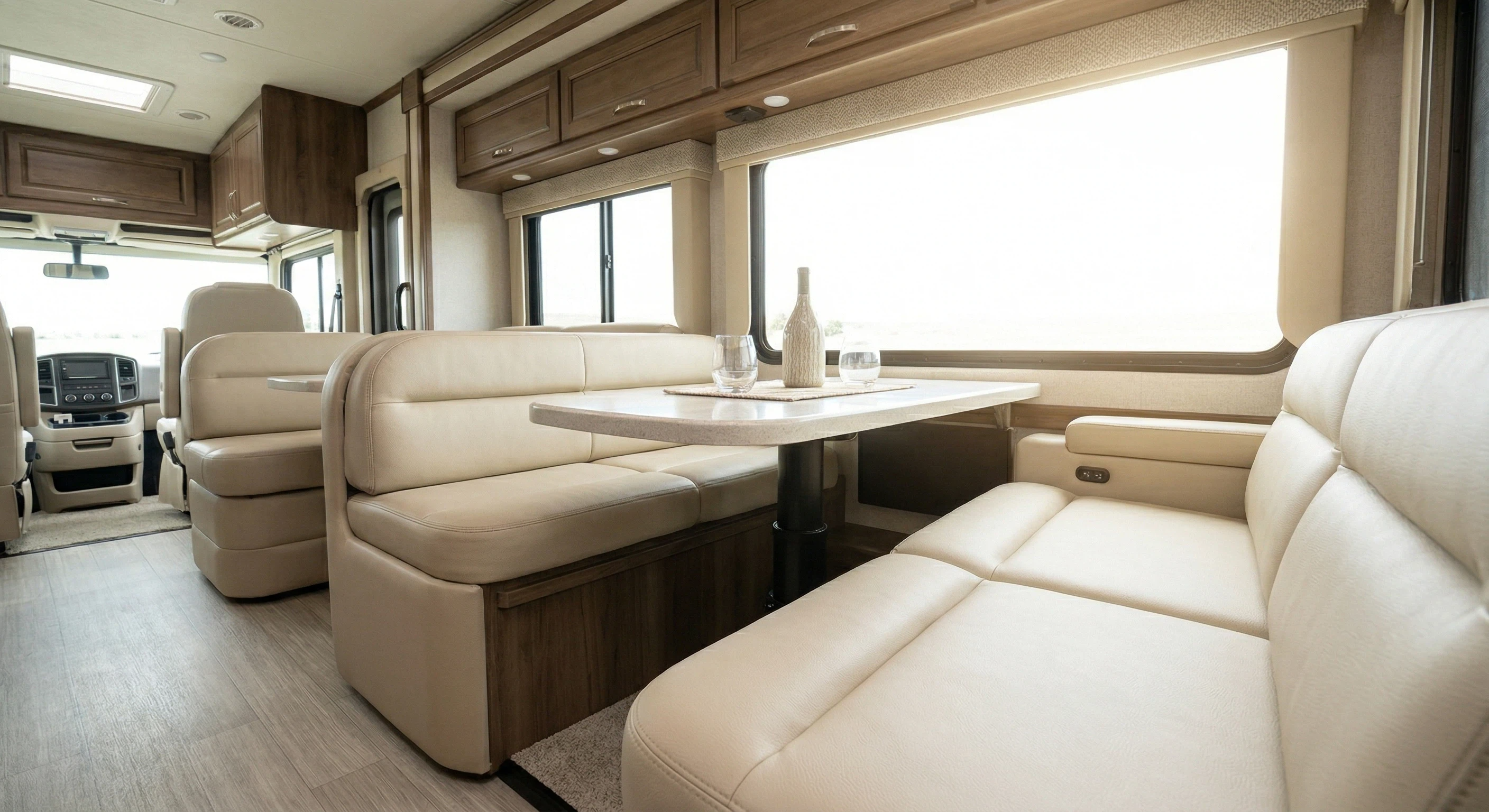
RV interiors require residential comfort combined with automotive durability, utilizing rv upholstery fabric, rv furniture fabric, and rv recliners leather. Golf carts and open-air buggies rely on weather-resistant golf cart upholstery fabric or specialized vinyl for golf cart seats.
5.3 Public Transit & Mass Transportation
Buses, coaches, and passenger rail systems require heavy-duty abrasion ratings and fire-retardant compliance. Standard specifications include coach faux leather, coach car interior fabric, railway upholstery fabric, and train upholstery fabric, often procured as continuous seat vinyl roll stock for broad installation.
5.4 OEM Automotive Interior
Directly addresses VOC and stain issues; synthetic leather complies with IATF 16949 and VDA 278 standards. The material offers UV resistance and cold resistance exceeding 1,000 hours, ensuring perfect fit to components. Interior products include vinyl for pontoon seats, heavy-duty vinyl fabric, RV vinyl, and leather motorcycle seat upholstery. In addition to OEM automotive leather and coach automotive leather, antibacterial vinyl and automotive silicone comfort leather are also offered. Land transportation materials meet FMVSS 302 standards, while aviation-grade materials (e.g., aircraft interior leather) comply with the FAR 25.853 flammability standard—delivering both cost-effectiveness and premium texture, making them ideal for safety seat and cabin upgrades.
5.5 Building Equipment
Effortlessly withstands high-intensity outdoor abrasion and puncture risks; automotive vinyl fabric delivers exceptional puncture resistance and >1,000 hours of QUV UV resistance, is highly compatible with vacuum forming processes, and serves as the ideal robust solution for durable excavator and heavy-duty agricultural machinery seats.
Meanwhile, the aviation industry imposes stringent requirements for lightweighting and ultimate flame retardancy, relying heavily on specialized aviation leather suppliers, aircraft leather suppliers, and aircraft upholstery fabric suppliers to provide aircraft faux leather, aircraft interior vinyl, commercial aircraft faux leather, military aircraft faux leather, aviation upholstery fabric, and aircraft seat upholstery fabric.
6. Interior Care and Routine Maintenance Guidelines
6.1 Maintenance Limitations of Natural Leather
As an organic material, natural leather is sensitive to environmental conditions. Its open pore structure absorbs perspiration, oils, and liquids, which can cause permanent staining. Maintenance requires pH-balanced leather cleaners and regular applications of conditioning creams to replenish lost lipids. Exposure to direct sunlight or low humidity without proper care leads to hardening, color fading, and surface cracking. Harsh chemical solvents, alcohol, or standard baby wipes can strip the protective topcoat, while unaddressed moisture can lead to mold growth.
6.2 Maintenance Advantages of Synthetic Leather
Modern synthetic materials—including automotive upholstery vinyl, automotive artificial leather, and vinyl car upholstery fabric—offer straightforward maintenance procedures:
Simple Cleaning Routine: The dense barrier surface prevents oil and water absorption. Dust and surface soil can be removed using a water-dampened microfiber cloth.
Stain Removal: Advanced silicone leather and water-based automotive interior vinyl fabric offer strong chemical resistance. Stains from ballpoint pens or grease can be treated with mild soap solutions or diluted isopropyl alcohol without compromising the finish or color.
No Conditioning Required: Synthetic polymers retain flexibility without added oils, eliminating the need for leather conditioners and avoiding greasy surface residues.
Environmental Resilience: High moisture and mildew resistance ensure that materials used for vinyl for seat upholstery or leather for seat upholstery maintain structural integrity in humid climates.
7. Strategic Selection: The Optimal Choice for Automotive Interiors
While natural leather remains a traditional symbol of luxury due to its heritage and soft hand-feel, its practical limitations—such as maintenance demands, wear vulnerability, and higher material costs—present challenges for daily use.
By comparison, modern vehicle upholstery vinyl, having undergone technological innovation, not only matches—often surpassing—genuine leather in visual appeal and tactile feel, but also demonstrates overwhelming advantages in abrasion resistance, UV resistance, ease of cleaning, stain resistance, non-toxicity, odorlessness, environmental friendliness, and overall cost-effectiveness. Considering comprehensive performance, health and environmental safety, and economic efficiency, synthetic leather—especially new-generation silicone leather and water-based PU—is undoubtedly the optimal material for automotive seat covers (Best Leather for Car Seat Covers).
8.FAQs
8.1 Which leather is good for car seat covers?
For car seat covers, Nappa leather (real or high-grade faux/PU) provides the best balance of ultra-soft comfort and luxury. High-quality PU faux leather is ideal for everyday practicality because it resists water and wipes clean easily, while genuine leather offers maximum longevity if you maintain it.
8.2 What are the downsides of leather seat covers?
Leather seat covers trap heat, lack breathability, become scorching hot or freezing cold with weather extremes, offer less grip than fabric, scratch easily, and cost more than other cover materials. Real leather also demands regular conditioning to prevent cracking.
8.3 What are the disadvantages of leather car seats?
Leather car seats have major downsides like extreme temperature sensitivity (burning hot in summer and freezing cold in winter), high upfront and repair costs, a slippery surface during sharp turns, and the need for regular maintenance to prevent cracking.
8.4 Is Nappa leather better than leather?
Nappa leather is not strictly "better" than standard leather, but it is a higher-grade, much softer, and more luxurious type of full-grain leather. Standard leather can be stiffer and thicker, making it more durable for rugged uses, while Nappa leather prioritizes plush comfort and a smooth finish.